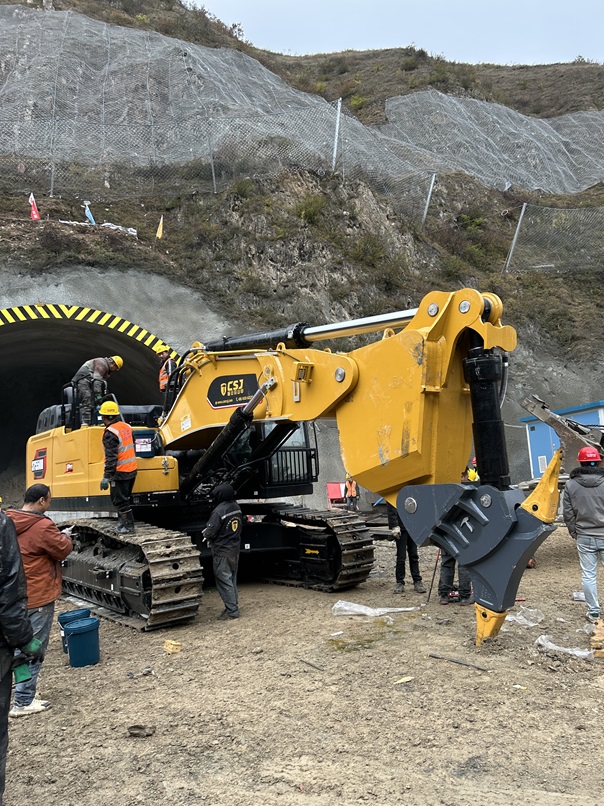
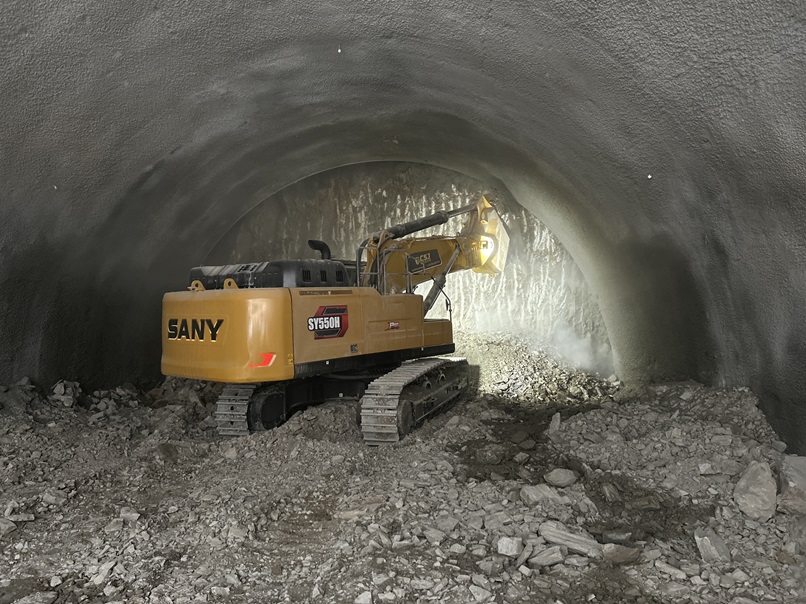
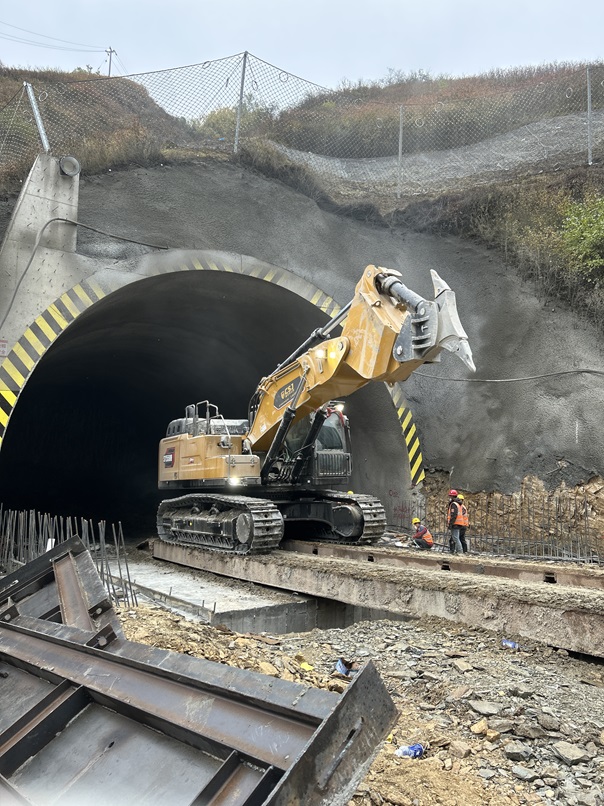
Recently, at a tunnel construction site in Tianshui, Gansu, a Sany 550 excavator fitted with Chang’an Chuanshanjia’s Upper-Lower Double Hook Tunneling Ripper has been operating steadily on the tunneling face. Following the retrofit, overall excavation efficiency under the same rock conditions improved by more than 100% compared with the original hydraulic breaker operation, providing strong support for the project schedule.
1. Project Conditions and Early Challenges
The tunnel’s surrounding rock is graded between Class IV and V—weathered, fractured and heavily jointed—a relatively difficult condition in tunnel construction. In the early stage, the crew used a conventional hydraulic breaker. Affected by the rock properties, the breaker’s impact efficiency dropped quickly and effective advance was slow; the rock broke unevenly and required secondary breaking, while muck removal was also held back, so the per-shift excavation volume fell short of schedule requirements.
Notably, the client attached great importance to this product and allocated ample on-site manpower; from early communication through equipment commissioning, coordination was smooth, laying a solid foundation for the subsequent rollout and efficiency gains.
2. Solution Selection: Sany 550 + Tunneling Ripper
Based on the above conditions, the client ultimately adopted our solution: retrofitting the existing on-site Sany 550 with Chang’an Chuanshanjia’s Upper-Lower Double Hook Tunneling Ripper. The choice of the Sany 550 was no accident—its power and undercarriage are sufficient to support heavy-duty tunneling, and it was already familiar and well-suited on site; what really needed strengthening was the working arm suited to this rock type. We carried out a matched design for this model, with the arm structure, hydraulic interface and operating parameters all determined according to the actual surrounding rock conditions of the Tianshui project and similar sites.
The working principle of the ripper differs fundamentally from that of a hydraulic breaker. The breaker relies on impact—hammering again and again; the ripper works through cutting, shearing and squeezing, advancing along the rock mass’s natural joint planes. For weathered, fractured Class IV–V rock, this approach has clear advantages: the rock already contains fissures, so advancing along them is far easier than brute force; it reaches full depth in one pass without repeatedly repositioning, and produces more uniform fragmentation.
A design point especially critical for tunnel conditions is that the front of the ripper’s stick is fitted with a double-head blade that can be switched to work upward or downward. The hardest parts of tunnel excavation are often not the middle section but the crown and the invert—the crown has little working space and the invert and floor are even tighter; conventional excavation is limited by structure and posture, frequently unable to reach or apply force, leaving crews dependent on manual assistance or constant repositioning, which is time-consuming and laborious. The up-down universal blade lets the same arm form an effective cutting angle in different postures: it can trim the crown profile upward and clean the floor downward, bringing the formerly inefficient zones into normal operation.
3. Application Results: 100%+ Efficiency Gain
After the equipment entered tunneling, the work rhythm improved markedly versus the breaker stage. The old cycle of “strike, retreat, reposition” disappeared; the ripper advances continuously after biting into the rock, with steady output; the excavated profile is neater than before, secondary breaking is greatly reduced, and muck removal flows more smoothly.
The change at the crown and floor is especially pronounced. Previously these positions had little space—the breaker couldn’t stand up or reach in, often requiring shutdown to reposition or even manual trimming; now the double-head blade trims the crown upward and cleans the invert downward, so a single machine position covers more of the profile, and the once most time-consuming sections became the smoothest part of the advance.
Overall, excavation efficiency under this condition improved by more than 100%. The significance goes beyond “faster”: it converts the effective working hours previously wasted due to rock incompatibility back into real advance, making the schedule more relaxed and improving utilization of crew and equipment shifts—a tangible cost advantage for the contractor.
4. Reflections and Closing
Two points are worth summarizing. First, select equipment by rock type, not by habit. Long-term hard breaking of Class IV–V rock with a hydraulic breaker is a classic case of “wrong tool”; when the rock is fragmented and jointed, the advantages of a cutting-type ripper are multiplied. Second, beyond efficiency, look at stability. The durability of structural parts and the maintainability of wear parts determine whether the equipment can sustain its performance across the whole project—a high single-shift burst doesn’t win; what counts is the full-cycle economy.
From this Tianshui tunnel, what changed was only the operating mode of one Sany 550; what remained constant is the basic logic of delivering schedule and returns. Facing the “neither hard nor soft” Class IV–V rock, choosing the right method often beats simply investing more. This 100%+ efficiency gain stems from the fit between product and site conditions, and reflects our consistent understanding of what “a usable machine” means.
If you are hitting efficiency bottlenecks in tunnel excavation or fractured-rock digging, contact Chang’an Chuanshanjia. We will first understand your surrounding rock and host model, then provide a targeted adaptation plan, with on-site installation and commissioning support.
Sichuan Chang’an Chuanshanjia Technology Co., Ltd. Website: www.cancsj.com | Hotline: 400-6020-850
© 2021-2026 Sichuan Chang'an Chuanshanjia Technology Co., Ltd. all rights reserved [Shu ICP Bei No. 18030366]